


Ketogenic Diets for Depression: What Two Recent Trials Really Tell Us

Updated: Feb 27
In 2026 we have seen the interest in ketogenic diets for depression moving beyond anecdotes and case reports and into formal clinical trials. Two recent studies published in the last few weeks have provided valuable signals about where this research might go in the future and what might be important to consider in relation to how we use a ketogenic approach as clinicians and clients.

There is a growing body of research that ketogenic diets can influence several mechanisms which are highly relevant to depression, including:
Improved mitochondrial function
Reduced neuroinflammation
Altered glutamate–GABA balance
Improved insulin sensitivity
Stabilisation of neuronal energy supplies
The two recent trials, one from Oxford and one from Canada, provide an early indication that ketogenic diets might be a valuable tool, however, they also highlight the very real challenges of studying a demanding metabolic intervention in people with depression.
Let’s look at each study in turn, their strengths, their weaknesses, and what they actually tell us about clinical practice.
📌 Trial 1: The Oxford Ketogenic Diet RCT for Depression
This was the first properly randomised controlled trial (RCT) of a ketogenic diet for depression, and therefore a major milestone for the field. The study, led by researchers at University of Oxford, compared a ketogenic diet with an active control diet in adults with treatment-resistant depression.

✅ What This Study Did Well
1. A real control group
This study had an intervention group and a control group, this is the studies biggest strength. Participants were randomised to either a ketogenic diet, or a structured control diet with equivalent support. This is important because it helps separates the diet effects from placebo, attention, therapeutic contact and other potential issues which might improve mood on their own.
2. High retention rates
Another benefit was that despite having depression and having to cope with the dietary restrictions 98% of participants completed the 6-week intervention. In addition, 93% provided follow-up data. This is unusually good for this kind of trial and shows the intervention was feasible under supervision.
3. A signal of symptom improvement
Both groups improved substantially, but the ketogenic group showed a slightly greater reduction in depressive symptoms at 6 weeks. The difference was modest and unfortunately did not persist at follow-up but the direction of effect matters in an early trial.
⚠️ Key Weaknesses (and Why They Matter)
1. Ketosis measurement was limited and indirect
Ketosis was assessed using urine ketone strips, not blood ketones. Urine ketones are a crude measure and do not correlate with blood levels of beta-hydroxybutyrate which is the ketone usually measured in similar trials. Urine tests acetoacetate which is known to become less reliable once keto-adaptation occurs. These test strips can easily be affected by damp environments, a problem since they are usually kept in bathrooms. Also testing was done only every two weeks, not daily, providing little idea of overall compliance with the diet. This means we don’t know who was consistently in ketosis and whether symptom changes tracked with depth or stability of ketosis.
2. Mood was not tracked alongside metabolic state
Mood was assessed at set intervals (at 2, 4, 6, an 12 weeks). There was no daily mood tracking and no attempt to correlate mood fluctuations with ketone levels. Therefore, we don’t know if changes in mood correlated with changes in metabolic state.
3. Short duration, no long-term follow-up
The active intervention lasted just 6 weeks, which is a normal period for RCTs but still a relatively short period. There was no long-term follow-up to assess durability or relapse after stopping the diet although it appears that by week 12 at follow-up only 9% of the ketogenic group were still following the diet nearly every day compared with 25% of the control group.
4. The control diet may not have been a true “Western diet”
This is subtle but important. The control diet simply asked participants to increase vegetables and reduce ultra-processed foods. This likely reduced the refined carbohydrate content of the diet and may have unintentionally excluded starchy carbs. In other words, it may have pushed people towards consuming a low carb diet which was metabolically beneficial in its own right, potentially shrinking the difference between groups. This makes it less likely that the ketogenic group would have a more significant difference and potentially blurs interpretation of the outcomes. The control diet also was called a ‘phyto diet’ which might have seemed more appealing and increased motivation. It also swapped out animal fats for unsaturated plant fats, although we have no details about this, and some plant fats such as olive oil still contain plenty of saturated fat. In fact this diet is similar to one used in the successful SMILES trial for depression.
5. A 4:1 ratio is difficult to sustain
One reason participants may have stopped adhering to the diet so soon even with the mood benefits might be that this trial used a 4:1 ratio. This is much harder to sustain, especially when preparing meals at home rather, than receiving pre-prepare food, and is likely deficient in protein requirements so not really a long-term option. In fact protein is essential for optimal neurotransmitter and many other brain energy related functions.
6. No metabolic data collected
There was no tracking of insulin resistance, glucose, lipids, inflammatory markers, mitochondrial or energy-related biomarkers. So while the trial was framed as a metabolic intervention, metabolism itself wasn’t measured.
7. Differences in Monetary Value of Vouchers
A final important point is that for those who chose not to receive pre-prepared ketogenic meals, they received £25, whereas the control diet group received an across-the-board amount of £10 to support their diet changes. It is possible that the monetary value might have influenced the outcomes between the groups.
📌 Trial 2: The Canadian Ketogenic Diet Pilot Study
The second study, conducted in Canada, took a different approach. It was a small, open-label pilot study, meaning everyone received the ketogenic diet, with no control group.
🔍 What They Found
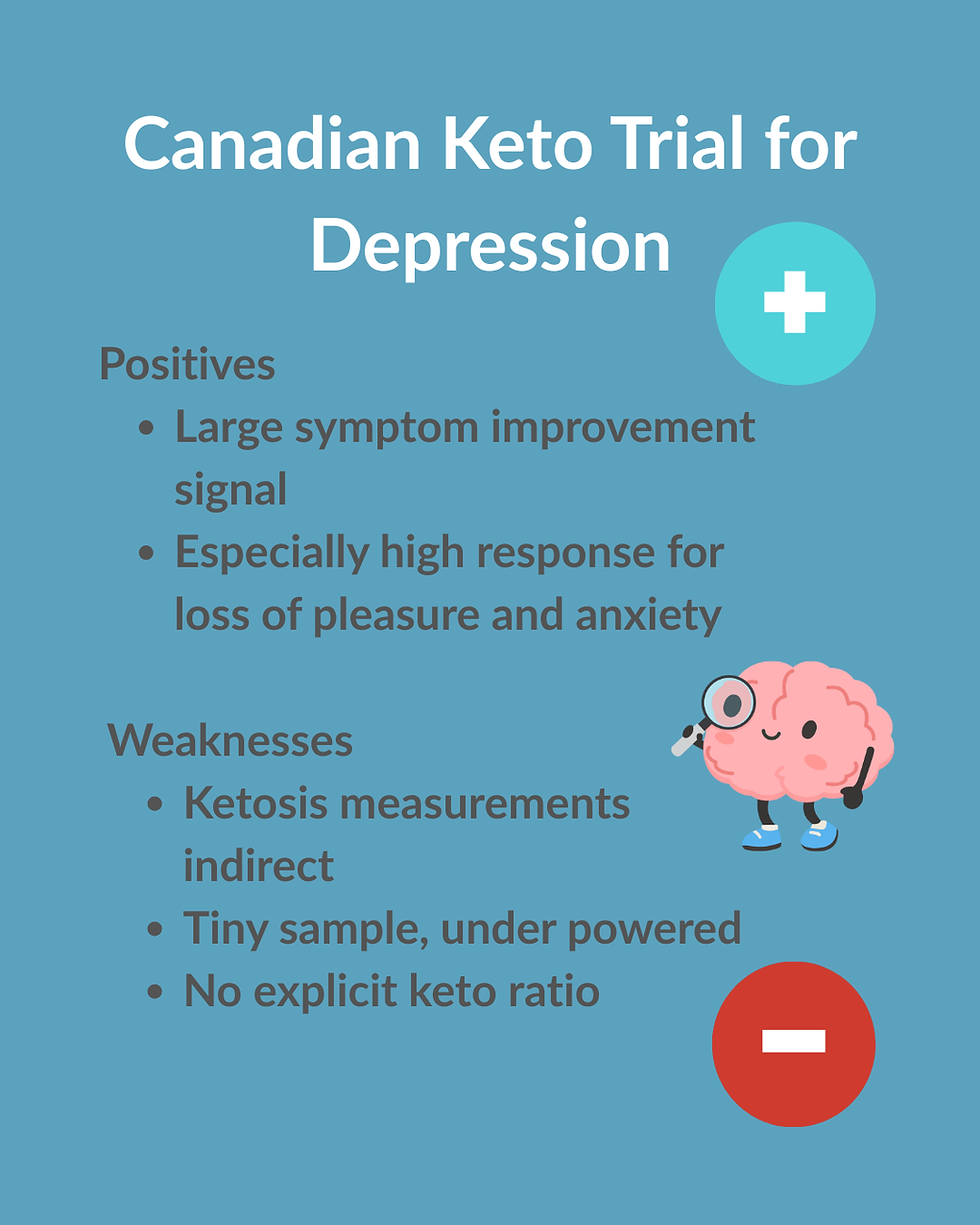
The sample was tiny, only 8 participants completing it, and recruitment was difficult, which reflects how demanding ketogenic trials can be to run in psychiatric populations. Despite this, the improvements in symptoms were large with a particularly interesting signal of improvement in anhedonia (loss of pleasure) and anxiety. These are symptoms that are often resistant to standard treatments.
⚠️ Limitations of the Canadian Study
1. No control group
This mean that the ketogenic diet did not have a comparator diet. This increases the risk of a result being due to placebo effects or increased expectation, or the therapeutic interaction.
2. Urine Testing
Again this study used urine testing of ketones instead of blood.
3. Very small, underpowered sample
The study was not powered to draw firm conclusions. Due to the small size of the trial, it was under powered meaning that it is difficult to say which the treatment, in this case the ketogenic diet, was effective as there is an increased risk of the result being a false negative. The results are therefore more useful to help generate future hypothesis to help conduct further research, rather than definitive.
4. Recruitment challenges
The difficulty recruiting participants highlights an important real-world issue that ketogenic diets are demanding, or at least that is the impression of the public. Not everyone with depression is ready or able to engage, or perhaps understand enough about what it entails at the outset.
5. No Explicit Keto Ratio
There is no explicit keto ratio mentioned, it simply states 20 g to 30 g of carbohydrate in the form of green vegetables and salad, and 80 g to 100 g of protein from animal based foods.
4. Micronutrient Supplementation
This trial also appears to have provided a multi-nutrient supplement which makes it more difficult to separate out the mechanisms that caused an improvement in symptoms, of course it is perfectly possible that there was a synergistic effect, both added to the benefits seen.
🔗 What These Studies Tell Us Together
These trials are an important step in building a credible early evidence base. They suggest that ketogenic diets can be implemented safely in people with depression under supervision. That some individuals experience substantial symptom improvements in situations where medication wasn’t able to help. The effects may extend beyond mood into anxiety and anhedonia. There was good adherence to the diet and both trials suggest that outcomes are better with frequent contact and adherence drops once support is withdrawn.
Going Forwards
Prior to this there were no published randomised control trials using a ketogenic diet for depression. They follow on from the KIND pilot which was a single arm ketogenic diet trial of college students with depression that I discussed in a previous post.
However, the good news is that there are several ongoing, recruiting, or planned trials which incorporate longer durations, larger numbers of participants, and also trials which combine the ketogenic diet with other treatments. Hopefully the next generation of trials will:
Identifying metabolic subtypes of depression.
Measuring ketone levels properly and frequently.
Linking mood changes to metabolic changes.
Testing longer durations with relapse follow-up.
Help our understanding of who benefits most, and why.

Practical Tips
How does this all of this help us as practitioners and clients? Here are some of the key pointers I have taken from this latest cohort of studies.
First, even improving your diet might be beneficial, cutting out processed carbs along with all the additives that comes with them is a great start. This means you will be consuming a more nutrient dense diet providing more micronutrients, helping balance blood sugar and reduce inflammation.
Second, if you are going to do a ketogenic diet then it needs to be really clear what this means. What ratio of ketogenic diet is it? What does this mean in terms of all three macronutrients; carbohydrates, protein, and fat? Is there a plan about how to transition into ketosis and how long you expect to be on that ratio for? It would be unusual to transition someone immediately onto a high ratio like a 4:1. More commonly you might transition to a low carb diet and then onto a ketogenic ratio in the region of 1:1 or 2:1.
Third, testing blood ketones is key, so you know that your metabolism has shifted over to burning fat, and to help optimise ketone levels. It is difficult to draw any firm conclusions from testing urine ketones.
Fourth, keeping a track of ketones in relation to mood can be useful to help find the sweet spot of ketone levels at which you feel best.
And finally, support is crucial, finding a source of ongoing support whether from a practitioner, your family, friends, or other like-minded people can be important to keep you on track for the long term. Remember if you are trying a ketogenic diet for serious mental illness discuss it with your mental health practitioners and get support from a ketogenic expert to make sure your safety is a priority.
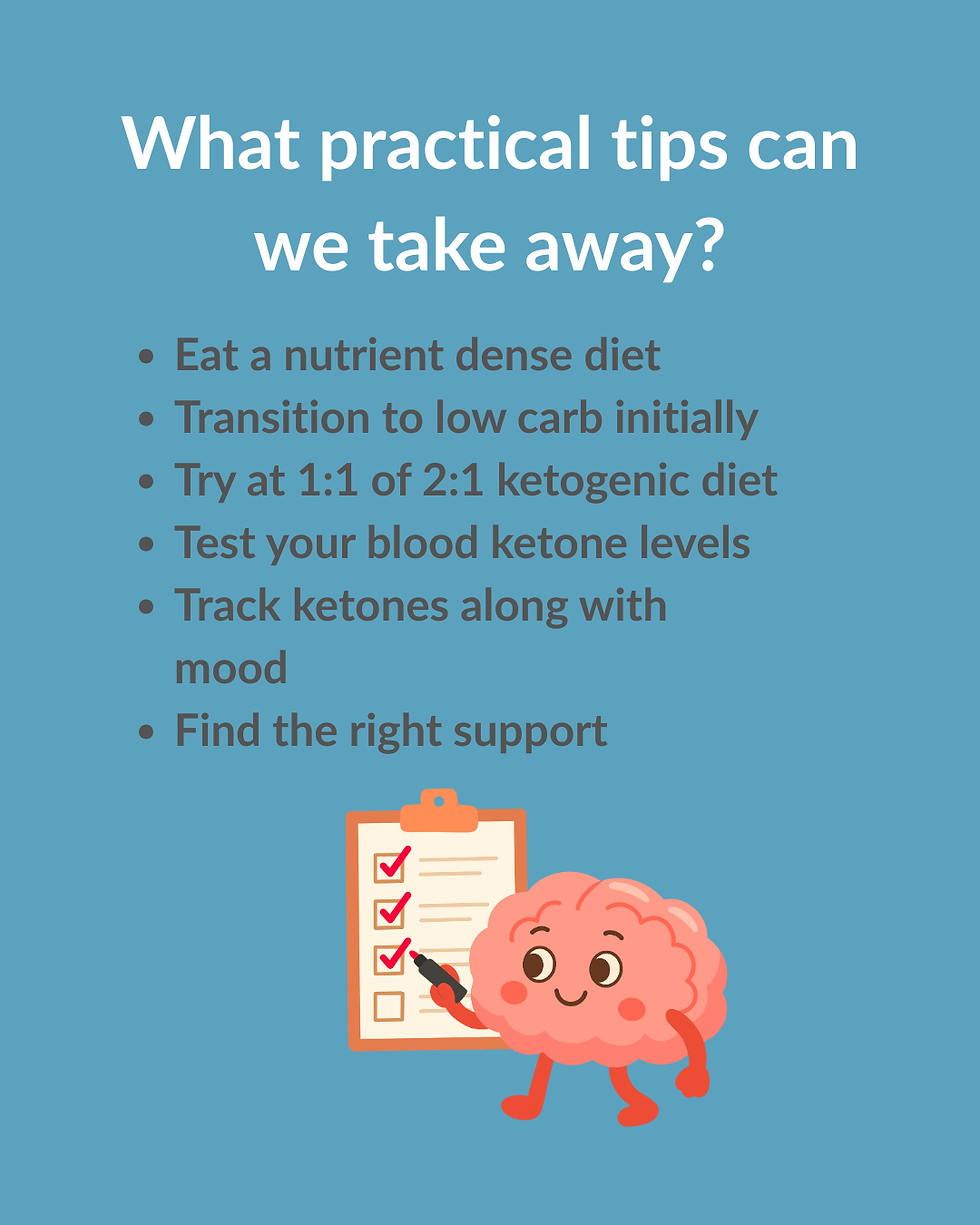
Practical take aways from the keto trials for depression.

If you would like a practical guide to restore and optimise your brain energy then download my FREE Ten Top Tips To Improve Your Brain Energy E-book.
It shares the key concepts that are important for you to grasp if you want to optimise your brain energy. It explains how brain energy works, what can go wrong with it and how you can improve it.
You can find it here.

You can also book a free 30-minute call with me to find out how I can help support you to achieve your health goals.
Disclaimer: Before changing your diet or lifestyle and taking any supplements always seek the advice of your doctor or another suitably qualified professional such as a nutritional therapist. The content of this blog is for informational purposes only and is not a substitute for professional medical advice. Always seek the advice of your doctor with regards to any questions you have about a medical condition.
References


Comments