


Bipolar Disorder & Brain Energy Research at the University of Edinburgh

I was very fortunate to be able to attend the Bipolar conference in Edinburgh last week co-hosted by the Royal College of Psychiatrists and Bipolar Scotland, a national lived experience organisation, supporting people affected by bipolar disorder. It was a very inspirational day listening to stories of lived experience relayed by brave individuals who shared their authentic, emotional and some times harrowing, real life experiences. Alongside this were presentations on several new studies that Edinburgh University have funding for which are investigating various aspects of brain energy regulation. As well as talks covering psychoeducation and support for people with bipolar disorder. It was a very enjoyable day full of questions and discussion from all points of view. It was one of the best events I have been at, there was such a lot of openness and a shared interest in supporting research to help find better answers and more hope.

Ketogenic Metabolism, Circadian Rhythms, Hormonal Transitions, and Co-Designed Brain Energy Science
A significant shift is emerging in mental health research. Large grants are being made available for research looking at various aspects of metabolic and mitochondrial psychobiology. In particular the bipolar disorder research at the University of Edinburgh is the centre of much of this activity. Rather than focusing narrowly on neurotransmitters or symptom classification, several interconnected research programmes are exploring a more fundamental question...
Is bipolar disorder better understood as a disorder of brain energy regulation, shaped by mitochondrial function, circadian rhythms, environmental light exposure, and hormonal transitions?
Across a series of studies—including the ENERGISE-BD ketogenic diet trial, the HELIOS-BD light sensitivity programme, the AMBIENT circadian rhythm studies, and the MENO-BD study for women with bipolar disorder—researchers are investigating how metabolic, hormonal, and biological timing systems interact to influence mood stability.

Importantly, this work is being shaped in collaboration with people with lived experience, including through co-design approaches involving Bipolar Scotland, whose members are participating in and informing several aspects of these studies.
Co-Design and Lived Experience: Bipolar Scotland’s Contribution
A defining feature of this research programme is the involvement of Bipolar Scotland, a national lived experience organisation supporting people affected by bipolar disorder.
Their contribution includes:
Input into study design and research priorities
Advising on feasibility and acceptability of interventions
Supporting recruitment and engagement across studies
Feedback on burden, monitoring tools, and outcome measures
Ensuring outcomes reflect lived realities (energy, cognition, functioning, sleep—not just symptom scores)

This co-design approach is particularly important in studies involving diet, circadian manipulation, and hormonal transitions, where feasibility and real-world sustainability are central to success.
It reflects a broader shift in mental health science: from research on people, to research with people.
The ENERGISE-BD Trial: Ketogenic Diet and Metabolic Psychiatry
The ENERGISE-BD programme explores ketogenic metabolism as a potential intervention in bipolar disorder. It builds on the results of a recently published pilot study which recruited 27 adults with bipolar disorder in a stable phase, many of whom were supported through engagement with lived experience networks including Bipolar Scotland.

The study examined the feasibility and adherence to a ketogenic diet, maintenance of nutritional ketosis over several weeks, mood, energy, and cognitive outcomes. The results showed that there was a positive correlation between daily ketone levels and self-rated mood and energy, and an inverse correlation between ketone levels and both impulsivity and anxiety.
ENERGISE-BD trial is the follow on from this, a much larger single blind trial that starts recruiting in October 2026 and is funded by the WEllcome Trust. In collaboration with Birmingham University, it will recruit 206 individuals who will be randomised to either a Ketogenic Diet or the Eat Well Plate alongside receiving their Treatment As Usual. The ketogenic diet will be 60-75% fat, 5-7% carbohyrates and 25% protein. Both groups will receive meals for the first 14 days. The ketogenic groups are aiming for betahydroxybutyrate levels of between 1.0 to 3.0 mmol/L daily. The EatWell Plate group will have glucose and ketones monitored too. The primary outcomes are a change in depression scores measured by the PHQ9 tool.

A lived experience advisory panel will provide input across the project informing agenda setting, feasibility and acceptability, project design, data collection and analysis, reporting and dissemination.
The trial aims to answer the question: could improving brain energy metabolism
improve bipolar depression? The hypothesis is that bipolar disorder involves instability in brain energy metabolism, potentially driven by mitochondrial inefficiency and impaired metabolic flexibility. A state of nutritional ketosis is being explored as a way to stabilise brain energy supply, reduce glucose variability and improve mitochondrial efficiency and neuronal resilience. The focus is on improving depressive symptoms.
HELIOS-BD: Light Sensitivity and Circadian Regulation
The HELIOS-BD study investigates how individuals with bipolar disorder respond to light and how this may influence circadian timing and mood regulation. This programme includes around 180 participants and examines retinal and circadian sensitivity to light, phase shifts in biological rhythms, differences between lithium-treated and non-lithium participants, sleep–wake cycle stability and variability.
Co-design input has helped ensure that light exposure protocols are tolerable and ethical, monitoring methods are minimally burdensome, outcomes reflect meaningful lived experience (sleep quality, energy, stability).
The hypothesis is that bipolar disorder involves altered sensitivity to light as a circadian input, contributing to instability in biological timing systems. This may increase vulnerability to circadian phase shifts, sleep disruption, subsequent mood instability.
AMBIENT: Real-World Circadian Rhythm Instability
The AMBIENT studies examines how circadian rhythms behave in real-world environments using continuous monitoring. This includes wearable tracking of sleep and activity, smartphone-based behavioural data, light exposure mapping and mood and energy reporting in daily life.
The goal is to understand how mood fluctuates in relation to sleep disruption, social and behavioural rhythms, seasonal light variation, environmental and lifestyle instability.

It is based on the idea that bipolar disorder involves reduced circadian rhythm stability, increased sensitivity to environmental timing cues (“zeitgebers”) and instability in sleep–wake–energy regulation systems.
From a mitochondrial perspective, circadian rhythms are deeply embedded in cellular metabolism, regulating:
ATP production cycles
Redox balance
Oxidative stress responses
Hormonal signalling that affects brain function
MENO-BD: Bipolar Disorder, Menopause, and Hormonal Transition
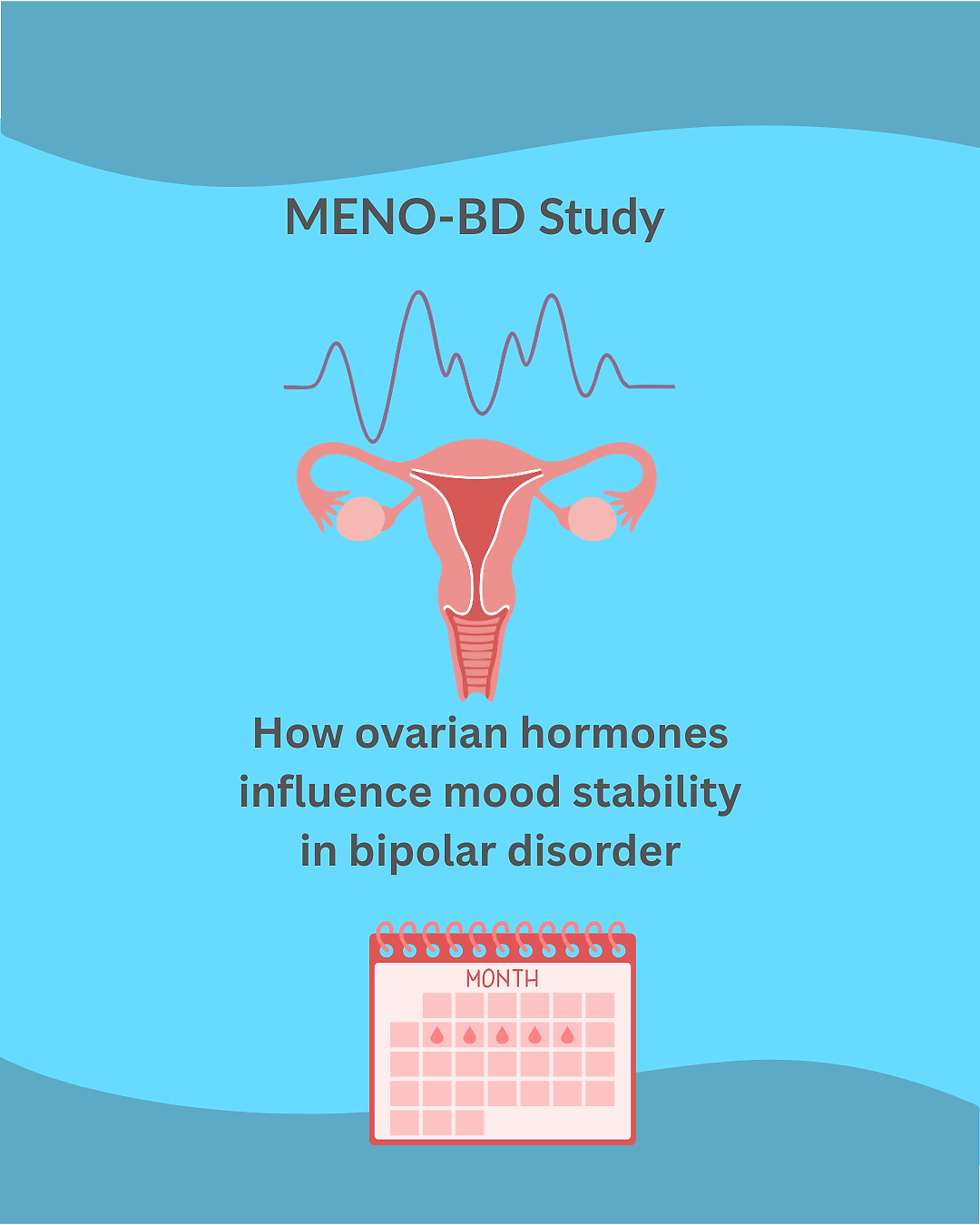
Another important and emerging strand of research is the MENO-BD study, led by Dr Katie Marwick at the University of Edinburgh. This study focuses on a critical but under-researched question, how do hormonal transitions—particularly perimenopause and menopause—interact with bipolar disorder?
The MENO-BD study is designed to better understand how fluctuating and declining ovarian hormones influence mood stability in women with bipolar disorder. It explores changes in mood cycling during perimenopause and menopause, interaction between oestrogen/progesterone fluctuations and mood regulation, effects on sleep, circadian rhythm stability, and energy levels, impact on medication response and relapse vulnerability.
From a mitochondrial and energy regulation perspective, sex hormones are not just reproductive signals—they are also:
Modulators of mitochondrial function
Influencers of glucose metabolism and insulin sensitivity
Regulators of neuroinflammation and oxidative stress
Key contributors to circadian rhythm stability
This suggests that hormonal transition periods may represent a metabolic and circadian stress test on brain energy systems.
The MENO-BD hypothesis is that hormonal transitions during midlife may destabilise brain energy regulation systems in women with bipolar disorder, increasing vulnerability to mood instability through mitochondrial and circadian mechanisms.
Metabolic Psychiatry
Although ENERGISE-BD, HELIOS-BD, AMBIENT, and MENO-BD differ in design, they converge on a shared conceptual framework.
Across Edinburgh University’s bipolar research programmes, a unified model is emerging:
1. Bipolar disorder as a disorder of brain energy regulation
Mood reflects underlying variation in:
Mitochondrial efficiency
Metabolic flexibility
Cellular energy availability
2. Circadian rhythms as the master timing system
Circadian systems regulate:
Sleep–wake cycles
Hormonal rhythms
Mitochondrial energy production
Emotional and cognitive stability
3. Light, behaviour, and hormones as interacting inputs
Mood stability is shaped by:
Light exposure (HELIOS-BD)
Daily behavioural rhythms (AMBIENT)
Nutritional state (ENERGISE-BD)
Hormonal transitions (MENO-BD)
With all of these studies co-design helps to ensure that biological research remains grounded in real world lived experience, feasibility and sustainability and with meaningful outcomes.
Taken together, these studies are attempting to help answer the question:
What if bipolar disorder is not only a disorder of mood, but a disorder of how brain energy is regulated across time—and how that regulation is influenced by light, diet, hormones, and circadian biology?

If you would like a practical guide to restore and optimise your brain energy then download my FREE Ten Top Tips To Improve Your Brain Energy E-book.
It shares the key concepts that are important for you to grasp if you want to optimise your brain energy. It explains how brain energy works, what can go wrong with it and how you can improve it.
You can find it here.

You can also book a free 30-minute call with me to find out how I can help support you to achieve your health goals.
Disclaimer: Before changing your diet or lifestyle and taking any supplements always seek the advice of your doctor or another suitably qualified professional such as a nutritional therapist. The content of this blog is for informational purposes only and is not a substitute for professional medical advice. Always seek the advice of your doctor with regards to any questions you have about a medical condition.
References


Comments